%20%20weekly%20briefing%20(6).png)
The generic 10%-off welcome email isn't as exciting as it used to be. UK fashion and lifestyle brands keep sending it because it's easy to automate, but does it really work?
Pion's latest research shows why it doesn't: this audience isn't short on discount codes, they're short on reasons to care about yours. And for a women's fashion brand trying to win female students, that distinction is everything. A student discount is one of the sharpest tools you have to reach this audience, but only if you design it around how they actually shop.
Students Don't Buy Products, They Buy Memories
Pion's PION100 research proves that this generation doesn't buy into a product necessarily, they buy into a cultural moment or memory discovered on their feeds, and shared with their friends and families.
A discount code disconnected from any of that content just reads as noise.
That's what marketing teams need to remember: it isn't about the biggest discount number, it's about whether the discount is attached to something worth talking about. For female students in particular, a well-placed student offer isn't a markdown, it's an invitation into a brand they already want to belong to.
This connects to a broader trust issue in how female students treat prices. PwC reported that 90% of Gen Z will pay more for a brand they trust and 79% delay buying until a sale specifically to judge whether the price feels fair. A recognised, verified student discount is one of the fastest ways for a fashion brand to signal that fairness and earn that trust.
Creating Community Through Scarcity
The instinct in retail marketing for women's clothes is to use scarcity to create urgency: "24 hours only" or "while it lasts." Gen Z women look at scarcity as a way to create a community.
A limited-run drop, a student-only access, a code that only a specific community has… These work as shared experiences for young women. Getting the discount becomes a collectible, something you saved money on and told your friends about.
This is exactly why a student-only discount outperforms a public sale for a women's fashion brand. Being a verified student unlocks something not everyone can get, and that gated access turns a price cut into a badge of belonging.
The Budget-Conscious Majority

The single largest shopping persona in our PION100 research, 38%, is a group funding their own lifestyles through work, loans, or savings. They're not shopping with a parent's card or unlimited disposable income, unlike some others. They're spending carefully because they really have to.
We found that this group is only able to spare around 5% of their budget on the products and services they actually care about. Everything else has to go to the boring stuff, like bills, rent and necessities. This cohort is constantly prioritising and deal hunting, actively working to close the gap between what they want and what they can actually afford.
That mirrors the national picture: UK Gen Z women expect their finances to worsen in 2026, according to YouGov. Women are also more likely than men to budget.
That has a direct implication for discount design: a student discount that lands at the right moment, for the right product, can be the deciding factor in which fashion brands get that 5% this month. For female students on tight budgets, the student discount is often the permission they need to choose you over a competitor.
What This Means for Fashion Brands: Discounts and Exclusivity

Pulling these threads together, four discount formats are worth evaluating against how this audience actually behaves:
- Evergreen student discounts: work best when they feel like an invitation into something, not a generic new-customer template.
- Seasonal offers: outperform regular discounts when they carry real culture signalling, and allows students to partake in a major moment (think: Mother's Day, April Loan Drop, Black Friday, etc).
- Creator referral codes: succeed because they're inherently social and validated by a trusted influencer, which matches how this audience already discovers purchases.
- Event QR codes: convert well when the discount is genuinely tied to a cultural moment already happening in their feeds rather than a retailer-manufactured "sale event."
The Final Takeaway
The discount formats that work all share one thing in common: they give the discount purpose beyond cutting price. Seasonal offers make it special for students; and allows them to partake in a unique cultural moment. Referral codes make it fun and personal, like they a recommendation from a trusted friend. Event QR codes make it social; students are part of a community. And of course, evergreen student discounts make students feel seen. Like brands understand their financial situation and make an effort to adapt.
The flat, unattached code does none of that, which is why it's the one format that reliably gets ignored.
For a women's fashion brand, the student discount is the single most powerful way to bring all of that together, because it is exclusive, social and community-defining by design. But it only works if the right students can actually claim it, and if you own the relationship that follows.
Why Pion's Student Verification Is the Best Way to Reach Female Students
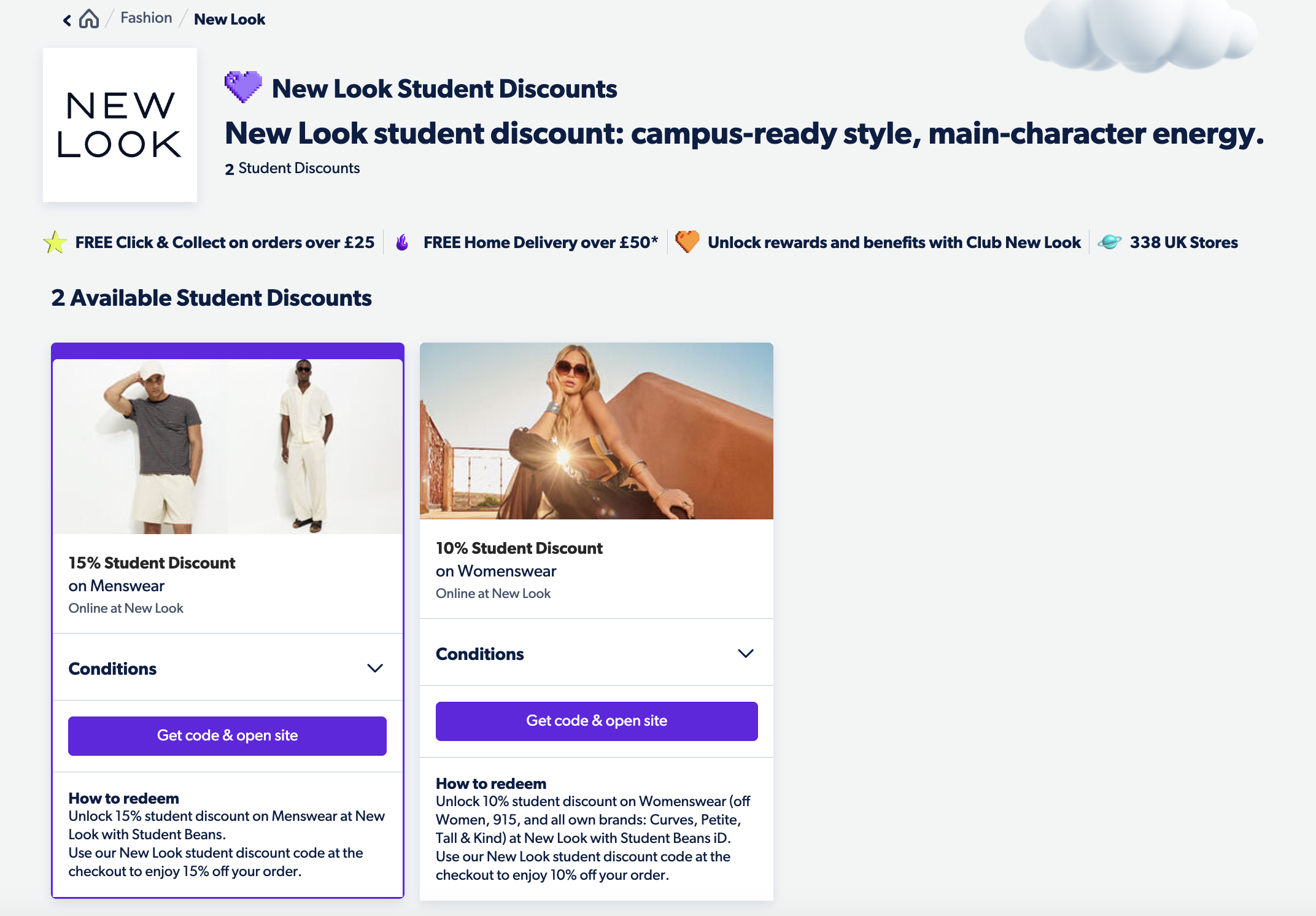
Getting this right is tricky, from the offer itself to the campaign behind it. That's where Pion comes in, through our Verify, Own, Reach model.
Verify: Pion lets you gate your student discount to genuinely verified female students, so exclusivity is real, not just a claim. That verification is what turns a code into a badge of belonging this audience actually trusts.
Own: Too many brands rent their growth on someone else's platform. Pion helps you own the student relationship and the first-party data behind it, so every discount becomes the start of a lasting customer relationship rather than a one-off transaction.
Reach: With millions of verified students across Student Beans and our wider network, Pion puts your brand in front of engaged female students at the exact cultural moments that drive them to buy.
{{ctaNeon}}
Read next...
%20_%20weekly%20briefing%20(1).png)
%20_%20weekly%20briefing%20(8).png)

Speak to an expert
To discuss what a student discount strategy built for how UK Gen Z women actually shop could look like for your brand.
Ready to start owning your growth?