Greggs x Student Beans: How a bus tour won Freshers’ loyalty
Carla Pelosoff · 19 October 2026


The retail death-knell has been ringing for years, with a lazy industry narrative claiming that Gen Z and Gen Alpha live entirely behind screens. But look closely at the high street, and a completely different picture emerges. Next-gen consumers are flooding back into physical spaces – provided those spaces offer something a screen simply cannot replicate.
The transaction is no longer the final destination; it is the launchpad for a circular ecosystem where physical presence fuels digital community, and digital community drives real-world traffic.
On the Connection Stage at YMS LDN, Pion Product Designer Rowena Liley sat down with Alice Burford (Head of Trading & Partnerships at Popeyes) and Victoria Frank (Marketing Manager at Pho) to explore the mechanics of an effective phygital marketing strategy. Together, they broke down how leading food and beverage brands deploy location-based marketing and smart in-store data capture to seamlessly bridge the gap between physical transactions and digital loyalty.
When auditing your high-street presence, focusing solely on immediate revenue share can cause you to miss the true value of youth audiences. At Popeyes, the student and Gen Z demographic – which they internally classify as the “on-trend” segment – makes up roughly 20% of their customer base. Yet, their commercial impact is massively disproportionate.
Young consumers are digitally vocal. They set consumer expectations, validate new locations, and lead the cultural conversation. By deploying an effective omnichannel youth marketing model that drives this cohort into physical stores, brands can trigger a ripple effect that influences older demographic segments.
For Pho, capturing this audience early is a long-term retention play. By embedding the brand into the student lifestyle during their university years, they create an organic habit that carries forward as those consumers transition into young professionals and start families.
Alice from Popeyes expresses:
“Students... set trends, validate certain silhouettes or certain products... if they like it, then everybody else kind of ends up liking it. Whilst they’re a smaller size, actually they influence the rest of our segments really heavily. They’re the ones that are talking the loudest digitally. So it’s really important that we keep driving our on-trend segment into restaurant because they influence everyone else significantly.”
To successfully pull next-gen consumers onto the high street, physical stores must stop operating like sterile transaction points. Brands need to invest heavily in digital-physical integration to make their locations environments where people actively want to spend time.
Popeyes achieves this by leaning into high-energy, experiential openings featuring live brass bands, exclusive merchandise, and a celebratory atmosphere. Similarly, Pho builds anticipation around new openings by collaborating with prominent digital creators, turning a basic restaurant launch into a must-visit cultural event.
Crucially, this content creation must feel entirely natural. Forcing digital elements onto a physical layout by plastering “Share this on Instagram” across a wall is seen as highly unauthentic by modern students. Instead, brands should let their products drive the interaction.
When Popeyes introduced their viral “Mega Dips” – oversized cups of dip designed for group sharing – they didn’t explicitly order their customers to post about it. The sheer, unexpected nature of the product naturally triggered curiosity, resulting in 7.5 million views and over 400,000 interactions on social media. The physical product inherently created the digital moment.
Victoria from Pho adds:
“An in-store space creates an online moment. We create a space where people can interact, they can build rapport, they can meet the staff... they can go, they can sit, they can eat, they can take pictures, they can take videos, and then they can share it online. If you’re in your bedroom, if you’re at home, your content’s limited... going out and meeting people bridges the gap between physical and online.”
The greatest challenge in omnichannel youth marketing is identifying your physical users and migrating them into your digital ecosystem. To execute this successfully, brands must shift from aggressive, one-sided data grabs to a clear, value-driven exchange.
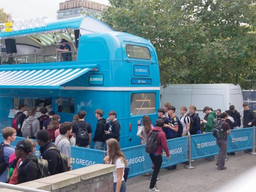
Pho executed this brilliantly by designing highly localized, physical student campus activations during the critical Freshers window. They deployed a “hole-in-the-wall” activation where students scanned an on-site QR code to access a free drink – with the link leading directly into Pho’s primary youth channel: Snapchat.
For Popeyes, driving sustainable app adoption relies heavily on removing physical friction at the point of sale. By upgrading their in-store digital kiosks to allow consumers to log directly into their loyalty app using their verified Student Beans credentials, they stripped away the barriers of manual form-filling. This frictionless integration has directly driven repeat purchase frequency across their campus locations.
To discover how the world’s leading brands leverage consumer-centric technology to remove friction and capture market share, check out our comprehensive PION100 Report.
To help you audit your brand’s physical footprint, here are the operational answers to the core questions raised during the session:
A: Yes. The narrative that Gen Z only shops online is entirely outdated. While the high street has undoubtedly evolved, youth foot traffic is surging for brands that treat their stores as social destinations. Gen Z consumers actively seek out physical spaces to connect, build real-world relationships, and escape screen fatigue. The caveat is that they hold brands to a higher standard of transparency, value, and experience than previous generations.
A: A phygital experience is the seamless merging of physical real estate with digital touchpoints. It matters because Gen Z does not view online and offline as separate channels; they see them as a single, fluid reality. A successful phygital framework uses physical experiences to inspire digital content, and digital infrastructure to simplify the physical shopping journey.
A: Through deep user-experience innovation. As highlighted by Pion Product Designer Rowena Liley, features like our integrated in-store ID Wallet allow students to instantly verify their status at physical checkouts without jumping through hurdles. Furthermore, our upcoming app features are specifically engineered to allow retail partners to broadcast live, real-world events and localized pop-ups directly to a pre-verified student audience, turning digital attention into physical footfall.
A: Pho focuses heavily on real-world experiential activations backed by digital continuation. Instead of keeping a flat discount year-round, they strategically boost their discount during high-intent calendar moments like the Freshers period. They combine this with high-impact, physical experiential data collection campaigns – such as wrapping a custom Airstream trailer to hand out thousands of free bowls of pho directly on university campuses – to ensure their first touchpoint with a student is unforgettably positive.
A: It requires a smart combination of footfall analytics, in-store digital kiosks, location-targeted social media, and dynamic app ecosystems. At an enterprise level, integrating app logins directly into physical kiosks is the gold standard for data capture. However, brands with tighter budgets can achieve excellent results by using contextual QR codes tied to platform-exclusive incentives or digital stamp cards.
The modern high street isn’t just a place to exchange goods for currency; it is your most powerful organic user acquisition tool. When you design physical spaces that naturally encourage content creation, remove transactional friction via retail tech Gen Z trusts, and offer a transparent value-exchange, you turn casual footfall into an optimized digital growth loop.
By prioritizing experiential value over simple transactional volume, your brand can build deep, generational affinity that begins on the high-street tiles and thrives across your digital network for years to come.
Ready to dive into the exact behavioral data, platform choices, and purchasing triggers defining the next generation of consumers?
Download our latest Freshers’ Report to master the localized activations and cultural moments that convert student audiences at scale.
Carla Pelosoff · 19 October 2026

Emily Jean-Mary · 15 October 2026

Amelia Lisco · 14 October 2026