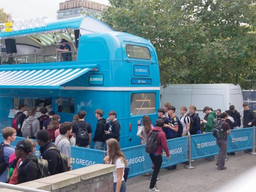
Greggs x Student Beans: How a bus tour won Freshers’ loyalty
Carla Pelosoff · 19 October 2026


A fast food establishment is the key for youth consumers. It’s a place to meet up after practice, a late night snack, or maybe where they get their first job. Beyond being a staple place in their lives, fast food goes beyond the assumption that low prices are what makes Gen Z Alpha consumers want to come back, instead its other things.
According to the PION100 UK, Food and Drink rank number two in the love to spend rankings with 59%.
Ranked number one on the PION100 UK of most loved brands is Greggs, with a score of 92%.
The brand offers quality, affordability, and genuine cultural relevance. The place offers options from a sausage roll to something vegan. It’s peak UK culture. It’s on about nearly every street corner.
“Gregg’s success shows that the most loved brands don’t just sell products, they provide cultural symbols that help young people express identity. When a bakery chain becomes this culturally significant, it’s because they’ve stayed true to who they are while genuinely understanding their customers.” Ash Waters, Head of Advertising at Pion
Beyond being a cultural landmark, Greggs works hard for 16–24 year olds navigating tight budgets. It offers affordable lunches and student discounts that actually make a difference to a weekly food spend.
Greggs Rewards ditches the traditional points-per-pound model in favor of something simpler and arguably more satisfying: buy a set number of items in a category and the next one is free. New app sign-ups also get a free hot or iced drink as a welcome gift. For a generation that already lives on their phone, this frictionless app design matters as much as the free food itself.
Ranked number seven of most loved brands, with a score of 88%.
McDonald’s is a key staple in youth culture, even more with their past summer campaign co-authored by young people across the UK, which featured regional slang for its restaurants (Maccers, McD’s, Maccys, McDizzles).
MyMcDonald’s Rewards is McDonald’s UK’s app-exclusive loyalty scheme, earning customers 1 point for every penny spent on menu items. Points can be redeemed for free food and drinks, or even donated to partner charities, a nod to the socially-conscious streak that resonates with younger consumers. The program leans heavily into gamification and frequent, app-only promotions, which keeps young customers opening the app even when they’re not ordering.
Ranked number nine of most loved brands, with a score of 85%. The key marketing strategy of Subway is the customization aspect of their menu, while they have staple sandwiches you can get, you can always change something out to fit your dietary needs. Beyond this, Subway has student discounts that make it a reliable lunch spot that doesn’t hurt the bank.
Subway Rewards recently simplified from a tiered, points based system into a flat 10% back in Subway Cash on every qualifying purchase. The change strips out the complexity of climbing membership tiers, making the value proposition instantly clear to a demographic that doesn’t have patience for complicated loyalty math.
All these places move beyond the industry’s assumption that price draws in consumers, instead they look to exclusivity with their deals on their apps or even app-based perks instead. Beyond this they follow three key strategies:
With secure student verification and exclusive discount strategies
Carla Pelosoff · 19 October 2026

Emily Jean-Mary · 15 October 2026
Amelia Lisco · 14 October 2026